
Winner of the Grawemeyer Award for Ideas Improving World Order
“This erudite, quick-paced book demonstrates what the mix of modernity and clans can create: ‘medieval Iceland plus Kalashnikovs.’” — The New York Times
“Accessible, mesmerizing, and compelling.” — New York Journal of Books
“A highly revealing study with global implications.” — Kirkus Reviews
“Nuanced … an entertaining mix of anecdote & ethnography.” — Publisher’s Weekly

Listen to podcasts and public radio interviews:
- Think, with Krys Boyd, on KERA (Dallas)—50 minutes:
- The Brian Lehrer Show on WNYC (New York)—12 minutes:
- The American Bar Association (Chicago)—15 minutes:
- ABC Radio National (Australia), Saturday Extra, with Geraldine Doogue—10 minutes:
- Central Standard, with Susan Wilson, on KCUR (Kansas City)—50 minutes:
- Trading Fours with Drs. Modeste and Wes (Blog Talk Radio)—55 minutes:
- The Kathleen Dunn Show on WPR (Madison)—50 minutes:
- Your Weekly Constitutional, with Stewart Harris—54 minutes:

From Across the Political Spectrum
“A brilliant book.” — Michael Curtis, Distinguished Professor Emeritus of Political Science, Rutgers University-New Brunswick, in American Thinker
“Brilliant … Raises one of the great questions of modern history. [What] is the function of the state? Weiner’s effort at an answer is one of the most distinctive of recent years.” —John Fabian Witt, Professor of Law, Yale Law School, in Cato Unbound
“Fascinating and original … violates disciplinary borders with grace and purpose. … His account makes it impossible to understand political authority in the traditional way.” — Stephen Utz, Professor of Law, University of Connecticut, in Concurring Opinions
“Mark S. Weiner argues with great eloquence and erudition.” — Daniel McCarthy, editor, The American Conservative, in Cato Unbound
“Weiner’s thesis is more consistent with the speculative tradition of Continental theory than with American liberalism. … It is a ‘popular’ legal history of the highest order … impeccably researched, well reasoned, yet accessible. Indeed, how could ripping yarns of blood feuds and honor killings be anything but a great read?” — Jeanne Schroeder, Professor of Law, Cardozo School of Law, “Family Feud”
“The best book I have read this year … A libertarian case for a strong central state … directly challenges what many libertarians currently believe.” — Arnold Kling, askblog and Library of Economics and Liberty
“Today [John Stuart] Mill’s heir on this matter might well be Mark Weiner, author of The Rule of the Clan.” — Jerry Taylor, “Why Libertarians Should Champion Social Liberty,” Niskanen Center
“Neoliberals, conservatives, and left commentators have all overlooked [its central finding] in varying degrees.” – Anna Dahlberg, Expressen (Sweden)
Reviews from Sweden
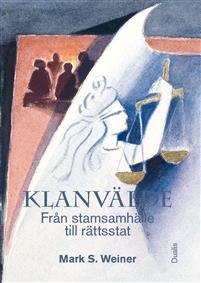
“One of the best and most important books of recent years.” — Per Brinkemo, Mellan Klan och Stat
“Filled with entertaining and interesting examples, as well both principled arguments and anecdotes, the book is clearly written and accessible to anyone.” — Svenska Dagbladet
“Vivid. … Read and contemplate!” — Dala-Demokraten
“Neoliberals, conservatives, and left commentators have all overlooked [its central finding] in varying degrees.” – Anna Dahlberg, Expressen
“Weiner argues convincingly that the state is the guarantor of the autonomy of the individual. Libertarians are wrong when they see a weakened state as necessary for individual freedom. In fact the opposite is true.” – Dagens Nyheter
“One of the most interesting interviews I’ve ever had.” — Paulina Neuding, Svenska Dagbladet
“Well-researched.”— Axess Magasin
“The Rule of the Clan isn’t a dry academic discussion … it’s a skilled narrative interwoven with stories of individual destiny on the border between integration and understanding. It’s well worth summer reading in the hammock.”— Norrköpings Tidningar
“A powerful plea for the strong state governed by liberal principles.” — Bengt G. Nilsson, Axess Magasin



… and from Denmark
“One of the most interesting books I have read in a long time … [Weiner] is a liberal who has seen the darkness … sharp as a razor’s edge in his analysis … highly recommended.” — Morten Uhrskov Jensen, Jyllands-Posten
… and from Australia
“25 Best Books I’ve read in 2020” — The Daily Chrenk
… and from Spain
From the Military and National Security Perspective
“Extraordinary.” — Doyle Quiggle, “Socratic Warfighters,” Small Wars Journal
“I often review good books. Sometimes I review great ones. The Rule of the Clan … gets the highest compliment of all: it is an academic book that is clearly and engagingly written so as to be broadly useful. … Strongest recommendation.” — Mark Safranski, Zenpundit.
“A delight: important, thoughtful social and legal analysis leavened by fascinating examples … Mark Weiner’s clean prose and impressive scholarship add up to a rare combination.” — Lt. Col. Wickliffe Walker, U.S. Army (Ret.), author of Goat Game: Thirteen Tales from the Afghan Frontier, in a review on Amazon.com
Lt. Col. (Ret.) Scott Mann, U.S. Army Special Forces, for The Stability Institute:

Political Philosophy, Sociology, and History
“Probably the best popular political philosophy book I’ve read in years.” —Mike Silverman, Red Letter Day, “Favorite Books of 2013“
“A brilliant new book. … While conceding that the state can be used for illiberal ends, [Weiner] insists that individual freedom cannot exist if it is not enforced by a powerful liberal state. He develops this argument by showing how weak or failed states have often created a vacuum of power that has been filled by the rule of clans that deny individual liberty.” — Larry Arnhart, Presidential Research Professor of Political Science, Northern Illinois University
“The book is not a dense read. You don’t need an academic knowledge of history or law to understand the points or the examples used. … It is an important book though. It’s one of those I had to keep putting down and thinking about before I moved on to the next bit. Rule of the Clan gives another clue to that often asked question, why did Europe and its New World offspring become so much more prosperous than everywhere else.” —Pieria
“This is one of the best political philosophy books that I’ve read in a long time. While authors like Nozick and Buchanan accept the normative ideal of a purely contractual society, but reject anarchy out of practical considerations, Weiner accepts the practical viability of anarchy, but contests the value of its normative ideal.” — Vlad Tarko, r3lativ
“Even the critics … acknowledge that his argument is stimulating and not easily dismissed. It is also very well written. It is definitely worth a read.” — The Sweep
“Timely.” — Mike Churchill, Churchill Research, “Best Books I’ve read in the past year”
“A virtual tour de force … a treasure trove for anyone trying to grasp the global drama which is currently unfolding I front of our eyes.” — Karen Schousboe, Medieval Histories
“It has been said that the past can be a reliable guide to the future. Mark Weiner’s The Rule of the Clan is a fascinating case in point. He dissects modern society to reveal the ancient form of social order from which it emerged, then portrays convincingly how those earlier forms can reassert themselves under certain conditions. His book should be of great interest to scholars of history, government, and human behavior alike.” — Rick Docksai, World Future Review
“Weiner … thinks the world’s proud individualists would be wise to recognize clan rule’s strengths (in both the merit and endurance senses of the word) as they work to spread liberal democracy.” — Stanford Magazine

On Amazon, Twitter, and Goodreads
“A powerful way to re-imagine the world. My biggest disappointment was that it needed to be longer.” — A reviewer on Amazon.com

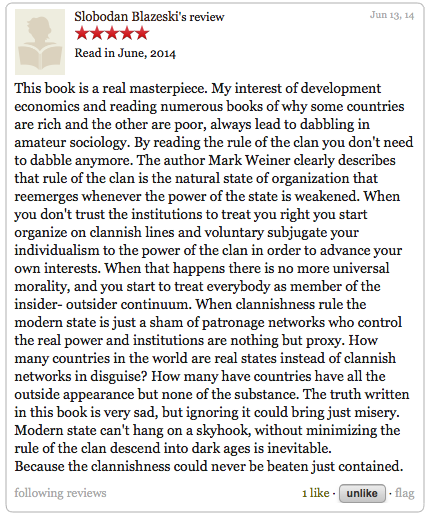
“This book shines a bright and clear light on clan society, a functioning world order that near totally conflicts with Western values. … The change for me in reading the news was night and day.” — A reviewer on Amazon.com

“Often, nonfiction does not hold my attention, even if it is about a topic that I thought would interest me. This book is an exception. Drawing upon others’ research as well as his own, Weiner shows convincingly (to me, at least) that family-based power will govern when few or no other structures exist in a society. He helped me understand the reasons for many actions and qualities of clan-like organizations. I now see patterns in many political and cultural struggles around the world today. The book flows along at just the right pace.” — A reviewer on Amazon.com

Jacket Endorsements (aka blurbs)
“The Rule of the Clan is a delight to read—an engaging tour of societies in which kinship groups have been the primary form of social organization, from Anglo-Saxon England to medieval Iceland to southern Sudan, modern India, the Philippines, and much more. It is also an insightful meditation on what proponents of individual freedom must grasp if they are to realize their aspirations in societies made up not of rational abstractions, but people like us.” — Rogers Smith, Christopher H. Browne Distinguished Professor of Political Science at the University of Pennsylvania
“Mark Weiner has raised the crucial yet neglected subject of tribal identity and loyalty in modern society. The sweep of his book and the depth of his analysis make it essential reading for anyone interested in connecting past to present in order to chart a felicitous path to the future.” — Amb. Akbar Ahmed, Ibn Khaldun Chair of Islamic Studies, American University
“The Rule of the Clan gives a fascinating glimpse into a world that few Westerners today understand: a world of honor, shame, collective responsibility, and violent feuds. This book tells us what we need to know if we really want to modernize the clan societies of the Middle East and central Asia—and if we want to save our own liberal democracies from descending into clannish chaos.”— Ian Morris, Jean and Rebecca Willard Professor of Classics and Professor of History, Stanford University, author of Why the West Rules—for Now
“A must read for anyone interested in understanding the complex relation between tribal identity, law, and custom, in seeking common ground between the Western and Islamic legal and political traditions, and in connecting the past to present in the service of legal reform.” — Abdullah Saeed, Sultan of Oman Professor of Arab and Islamic Studies at the University of Melbourne
“The Rule of the Clan confronts an uncomfortable but important reality. In the process it challenges the careless liberal assumption that national identity is an anachronism and a strong state a threat.” —Paul Collier, Director for the Center for the Study of African Economies at the University of Oxford, former director of the Development Research Group of the World Bank
“Perhaps the least publicized obstacle to the development of the rule of law and respect for individual rights in the Middle East and elsewhere has been the persistence of clan-based systems of justice. Mark Weiner’s The Rule of the Clan underscores eloquently the historical role of the clan in societies as diverse as medieval Iceland and the present-day Palestinian Authority. But Professor Weiner’s book goes beyond historical exposition to raise, backed by copious research and cogent examples, the urgent question: how and whether the transition from clan-based systems of justice to systems based on the rule of law, which have in the past taken centuries, can be accomplished in our time, when the need for change is as apparent as the resistance to it is entrenched.” — John J. Farmer, Jr., Senior Counsel, 9/11 Commission; Dean, Rutgers-Newark School of Law
An Interview for the Grawemeyer Award
Other Resources:
Click here to read an excerpt.
Click here to read an interview with the blog Concurring Opinions.
Click here to read a week-long online academic symposium about the book on Concurring Opinions, with an international group of participants.
Click here to watch a lecture about the book’s national security implications at the Kennedy Center for International Studies at BYU and here for a panel discussion at the Clarke Forum for Contemporary Issues at Dickinson College.
“The Call of the Clan” … En Français!: “De l’Union européenne à l’Afghanistan … L’appel du clan”
“The Paradox of Individualism” … ¡En Español!: “La paradoja del individualismo moderno”
Discussed u hrvatskom! by Zvonimir Šikić
Available through Amazon, Barnes and Noble, Books-a-Million, IndieBound, Overstock, Powell’s, other on-line stores, and at a local bookseller near you.
 Worlds of Law